
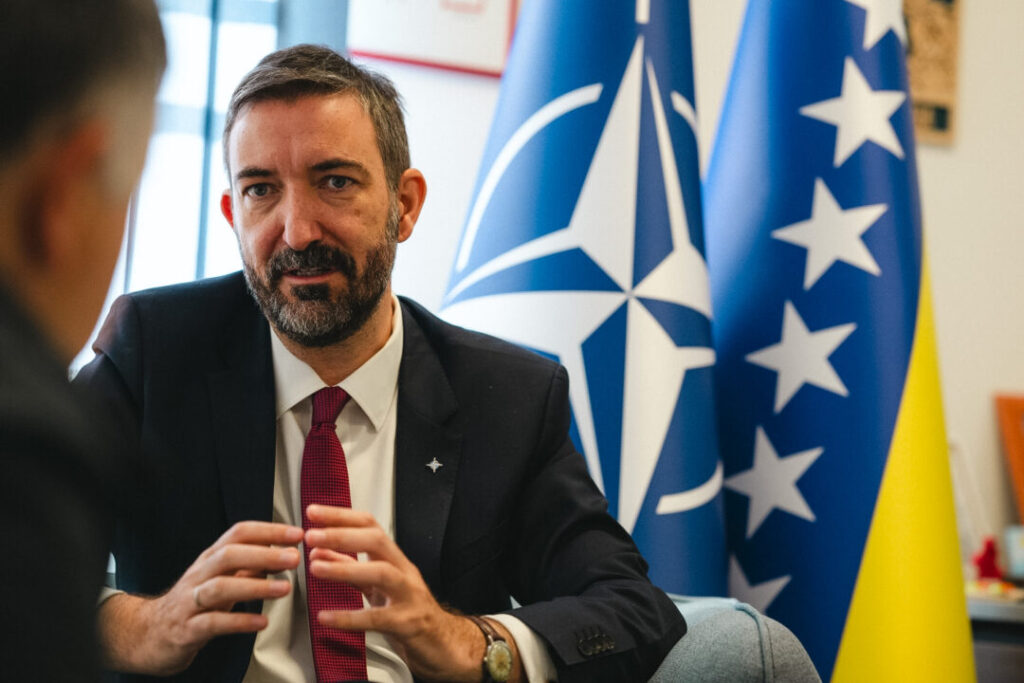
SARAJEVO (from our correspondent). The Political Engagement Support Cell (PESC) in Bosnia Herzegovina, established in July 2024 in Sarajevo, is a NATO Satellite Office (NASO) reporting to HQ Brussels with the main aim to support realization of NATO’s objectives in Bosnia and Herzegovina by facilitating political dialogue, promoting partnership cooperation, and contributing to strategic communication.
Report Difesa, interviewed exclusively the Ambassador Vladimir Vucinic.
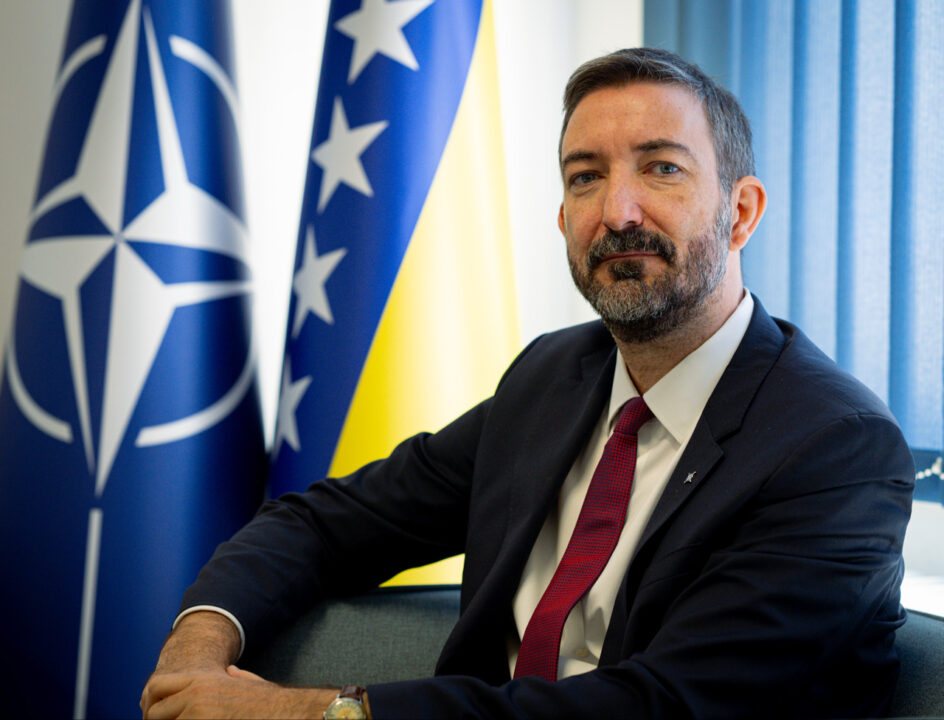
Ambassador Vucinic leads the Political Engagement Support Cell (PESC) in Bosnia Herzegovina and is a career diplomat with extensive experience in European and Euro-Atlantic affairs and multilateralism.
Worked both in Podgorica and Brussels on the integration of Montenegro to the EU and NATO and headed the Permanent Mission of Montenegro to the UN in NYC.
Prior to the position of the Head of NATO’s Political Support Engagement Cell (PESC) in Sarajevo, as part of NATO Satellite Offices (NASOs) network, occupied the position of Ambassador at Large for Cyber Security, pioneering this role within the Western Balkans.
Ambassador, what results have been achieved in the 20 years of the Partnership for Peace?
This year marks 20 years since BiH joined NATO’s Partnership for Peace in 2006. BiH was subsequently invited to the Membership Action Plan in 2010 and has since developed increasingly structured cooperation with NATO.
The past two decades demonstrate how much can be achieved through sustained political dialogue and practical cooperation.
NATO Headquarters Sarajevo has been conducting defence and security sector reform in BiH for over two decades [and am sure Commander Fowler explained this already].
In July 2024, NATO Headquarters additionally strengthened the Alliance’s presence in BiH, though the establishment of the Political Engagement Support Cell (PESC) in Sarajevo.

The aim is to further enhance the political dialogue, the practical cooperation and outreach. This is an important evolution in NATO’s engagement in Bosnia and Herzegovina.
The country has been participating in the Planning and Review Process (PARP) since May 2007.
PARP has, for almost two decades, provided a structured basis for identifying forces and capabilities that could be available to the Alliance for multinational training, exercises and peacekeeping and crisis management operations.
It also served as the principal mechanism to guide and measure defence and military reform progress.
In October 2025, NATO and BiH jointly agreed the country’s first Individually Tailored Partnership Programme (ITPP).
The Programme provides a comprehensive framework for our cooperation and reflects priorities, covering the period from 2025 to 2028.
The Reform Programme is also a very important tool in our partnership, which helps BiH institutions identify reform activities that they intend to undertake and facilitates the provision of support by NATO toward these efforts.
In a bit over one year, BiH has delivered three Reform Programmes.
Our cooperation is also becoming increasingly practical.
The Defence and Related Security Capacity Building (DCB) Package, endorsed by Allied Defence Ministers in 2023, contains initiatives designed to strengthen BiH’s own defence and security capabilities, including crisis management, cyber defence, counter-terrorism and other areas.
This is important: NATO’s approach is to help partners develop sustainable capabilities of their own.
So, if I had to describe these 20 years in one sentence, I would say that the relationship has evolved from partnership mechanisms into an increasingly broad, practical and mutually beneficial cooperation.
PESC is part of that evolution – bringing NATO’s political engagement closer to people and communities across Bosnia and Herzegovina.
Can I assume the cyber attacks are of Serbian or Russian origin?
So this is what we are doing here, is really building up the resilience of the society, but also the institutions.
And our initiatives like the one that is on the DCB is very much concentrated on the Ministry of Defence and developing their cyber security capacities and capabilities so that they are able, of course, to defend from any attacks from the threat countries.
This is something that we are facing also within the Alliance, but also in other partner countries as well.
NATO’s presence since the end of the Balkan wars of the 1990s has marked a long period of stability and security. If NATO were to end its presence here, what could happen for Bosnia and Herzegovina?
I would be careful about hypothetical scenarios. NATO has no intention of disengaging from BiH.
Our commitment to BiH’s sovereignty and territorial integrity – in accordance with the General Framework Agreement for Peace (GFAP) in Bosnia and Herzegovina and other relevant agreements – to lasting peace and security in the country and to stability across the Western Balkans remains firm. This has been confirmed on numerous occasions by SG and DSG as well.
What has changed over the past three decades is the nature of NATO’s engagement.
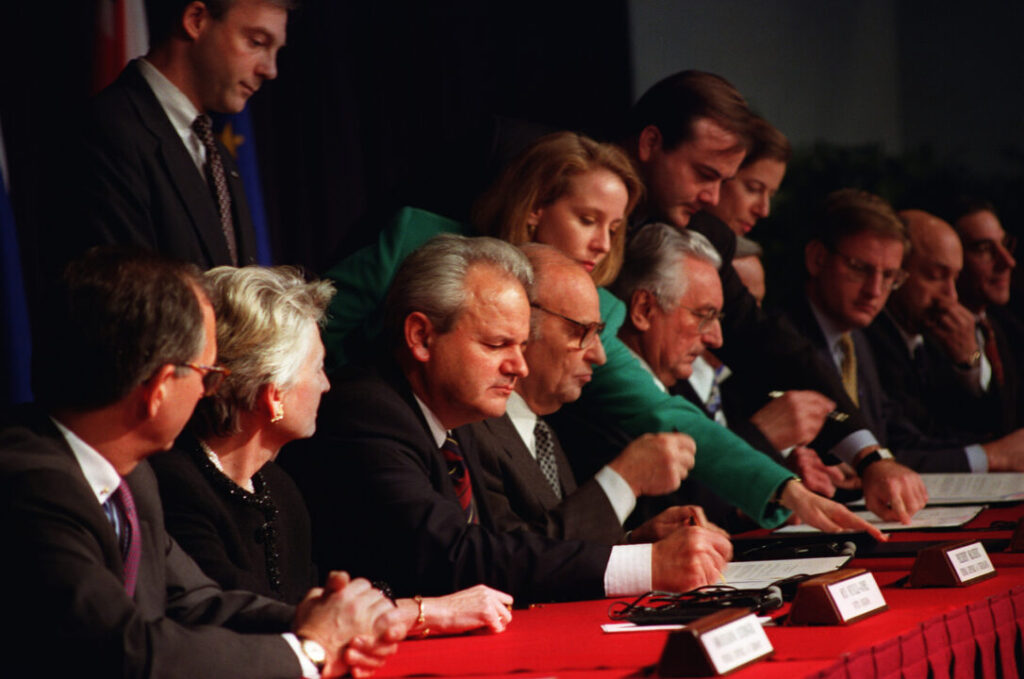
NATO played a key role in implementing the Dayton Peace Agreement through IFOR and subsequently SFOR.
In 2004, primary responsibility for the military aspects of the Peace Agreement was handed over to the European Union, and NATO has continued to support EUFOR Operation Althea under the Berlin Plus Arrangements.
The important point is that NATO’s engagement has evolved as circumstances have evolved.
It has moved from large peace-support operations towards partnership, reform support, capacity building, political dialogue and resilience.
For us in PESC, partnership means talking not only with institutions and political representatives but also reaching beyond them.
We engage with media, civil society, academia, young people and other stakeholders across BiH.
We want to listen as much as we explain: to understand perceptions, concerns and expectations, and at the same time provide factual information about what NATO does, what our partnership with BiH delivers and what it does not mean.
That is particularly important in today’s information environment. Resilience is not only about military capabilities. It is also about strong institutions, informed citizens and societies that are better able to withstand disinformation and other malign influences.
NATO is here to stay. As I have already pointed out, we constantly and continuously work to strengthen and further develop that partnership.
We assess the security situation as stable. However, as the Secretary General and other NATO officials have consistently repeated, NATO will not allow a security vacuum to emerge Stability in the Western Balkans region and security across the whole Euro-Atlantic area are interlinked.

For BiH, our focus today is therefore on helping the country become more resilient, supporting reforms and domestic capacities, maintaining political dialogue and working together with our international partners.
Ultimately, sustainable security has to be built by the institutions and citizens of BiH themselves.
NATO has consistently encouraged the authorities to continue comprehensive reforms – for the benefit of all – and to make full use of the partnership tools already available. NATO can provide expertise, assistance and tailored support, but sustainable reform requires strong national ownership and commitment.
And for the Balkans?
The Western Balkans remains a region of strategic importance for NATO.
As you are well aware, Albania, Croatia, Slovenia, Montenegro, North Macedonia, and other countries from the wider region, are part of our NATO family.
As I have said before, stability here matters not only for the people of this region; it matters for Euro-Atlantic security more broadly.
NATO’s engagement in the Western Balkans is therefore long-term, but it is also tailored to the circumstances of each partner and each situation.
It reflects a free and sovereign choice made by the BiH authorities to formalize their relations with NATO; and it is tailored to the country’s security needs.
There is no one-size-fits-all approach. I have already explained our extensive cooperation with BiH.
In Kosovo, the NATO-led KFOR mission operates under its long-standing United Nations mandate, based on UN Security Council Resolution 1244 of 1999, and continues to contribute to maintaining a safe and secure environment for all people and communities living in Kosovo. KFOR coordinates closely with the Kosovo Police and the EU Rule of Law Mission in Kosovo (EULEX), in their respective roles as security responders.
NATO is currently gradually adjusting KFOR’s posture following improvements in the security situation.
But NATO has been equally clear that this process is conditions-based, gradual and reversible if security developments require it. KFOR will retain the capabilities, readiness and flexibility necessary to fulfil its UN mandate.
At the same time, NATO continues to strongly support the EU-facilitated dialogue between Belgrade and Pristina, as the framework for resolving outstanding issues in a way that respects the rights of all communities.
Serbia has a long-standing partnership with NATO. We respect Serbia’s stated policy of military neutrality. We want to strengthen our relations, based on mutual respect and trust, and Serbia’s genuine contribution to regional stability.
In May, we held the first dedicated NATO-Serbia military exercise. Joint training contributes to strengthen NATO-Serbia practical cooperation, and it helps to support stability in the Western Balkans, for the benefit of all.
We welcome the ongoing coordination between the Serbian Armed Forces and KFOR.
These are different instruments and different mandates, but they reflect the same strategic objective: lasting stability, security and cooperation in the Western Balkans.
That combination is important: security on the ground, political dialogue and local responsibility have to reinforce one another.
The Western Balkans has changed enormously since the 1990s. NATO’s objective is to help ensure that the region continues moving forward rather than returning to the divisions of the past.
NATO believes that this region still has far more to offer than it has yet had the opportunity to contribute. A more self-reliant, and less dependent on external support and intervention.
We want to see a region that leads with dialogue and reconciliation rather than divisive rhetoric and escalation.
NATO has different engagements in BiH, Serbia and Kosovo, with different mandates and institutional frameworks.
But the broader principle is relevant: NATO adapts its engagement to conditions; and remains fully committed to regional stability, for the benefit of all.
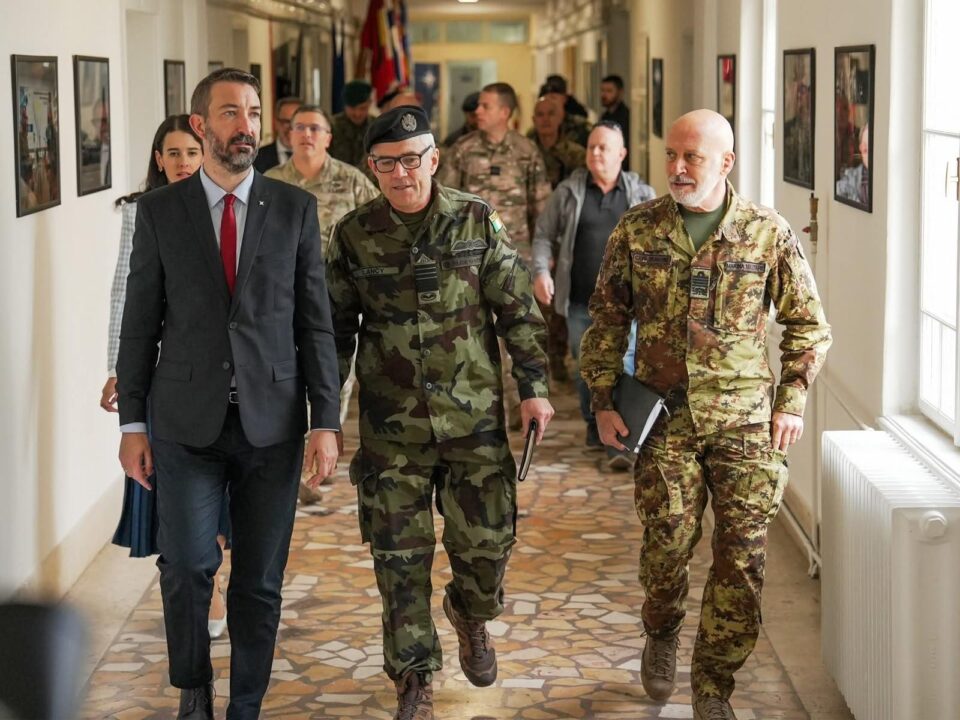
On October 4, Bosnia and Herzegovina will hold general elections. Are you concerned about a possible resurgence of political extremism?
Elections are first and foremost a democratic process belonging to the citizens of BiH. NATO does not comment on individual candidates, political parties or electoral outcomes.
What matters to NATO is that democratic processes take place peacefully, that institutions function effectively, and that political differences are addressed through dialogue and established democratic procedures.
We are, of course, attentive to developments that could affect stability.
This includes inflammatory rhetoric, attempts to deepen divisions, disinformation and other forms of malign influence.
These are challenges that are not unique to BiH; they affect many of our societies, both in allied countries and also in our partner countries.
Political leaders should show greater responsibility. It is about giving people the confidence to build their future here. This beautiful country has a lot to offer.
That is why engagement with younger generations is so important for us. Young people should have the opportunity to ask difficult questions directly.
To ask for accountability from their political leaders. To hear from us what NATO actually does and to form their own views based on facts rather than stereotypes or disinformation.
This is part of what PESC brings to NATO’s enhanced presence in BiH: a political and outreach capacity on the ground that can listen, explain and maintain dialogue across different parts of society.
Our expectation of all political actors is straightforward: constructive dialogue, respect for democratic institutions and a commitment to peace, stability and the functioning of the state.
If so, what could happen politically and in terms of relations between NATO and the government?
Again, I would avoid speculating about election results or hypothetical political configurations. NATO’s relationship with BiH and its institutions, and our partnership is built on frameworks and commitments developed over many years. Those will remain and will further strengthen.
However, challenges to the constitutional order and rhetoric that undermines the foundations of peace remain a red line. Contingency plans exist in the case of an escalation of the security situation.
Our approach after the elections will be shaped along existing structures. However, as the world transforms, so does the Alliance. NATO 3.0 is taking shape and it will have repercussions for Europe, for the Western Balkans and for BiH.
We will continue to work with the BiH institutions, support political dialogue and practical cooperation, and encourage reforms that strengthen the country’s institutions, defence and security capabilities and resilience.
At the same time, partnership should be a two-way process. NATO can provide expertise, assistance, capacity building and political engagement, but ultimately progress requires national ownership and political will.
NATO expects BiH to evolve from a recipient of support into a contributor to security.
Ultimately, when BiH starts contributing in a different manner, BiH will be getting more from its relationship with NATO: greater access to expertise, innovation and standards; more capable and interoperable armed forces; stronger resilience against cyber and hybrid threats; and new opportunities for its defence industry.
The idea is – if BiH can summon the political will to advance its longstanding partnership with the Alliance, it can use that relationship to connect with an expanding security network reaching well beyond the Euro-Atlantic area.
This was also the message when BiH’s Presidency met NATO’s North Atlantic Council in May. NATO underlined its readiness to deepen cooperation, building on the ITPP, the Reform Programme and the Defence Capacity Building Programme, while stressing that NATO’s support needs to be matched by credible national efforts, including by allocating appropriate financial resources for the further development of BiH national armed forces.
PESC will continue to play its part in this process.
We will maintain political dialogue, broaden engagement and outreach and help ensure that NATO’s policies and activities are understood accurately across BiH. That two-way dialogue matters, especially in politically sensitive periods.
Our engagement is designed to contribute to a BiH that is more secure, more resilient and increasingly able to provide for its own security – for the benefit of all its citizens.
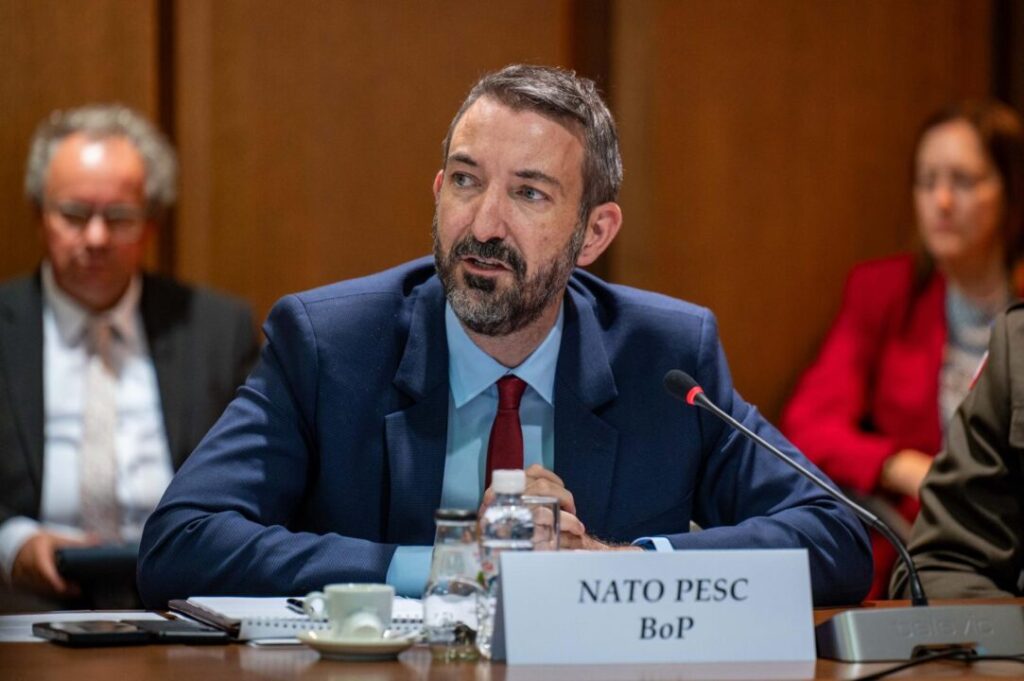
Ambassador, the future of this country, is it possible only with the help of the NATO?
So what we are trying to achieve, as I told you, what message we are sending is really that this country which is one of the most beautiful countries I saw, has a lot of potentials, and especially among the young people that we are talking to.
And we want to provide them with that future, and we want to give them the opportunity to live here, to stay here, and not to leave this country.
And this we can do through our investments, through the practical cooperation, increasing the resilience of the country, but also with this message that we are sending to the political leaders, that they have to take over the responsibility, that they have to take the ownership of the processes, and they have to be held accountable for what they are doing here.
And I think this is really important that what we were just mentioning before was that yes, we are here, we will help them as much as we can, we will provide the assistance, but it’s up to the national institutions and leaders to take over the responsibility and ownership of these processes, because that is the only way forward, and of course it will not be only NATO who is helping, there is the EU, our essential partner, there are other organisations, allied embassies here, that are providing a lot of help.
©RIPRODUZIONE RISERVATA