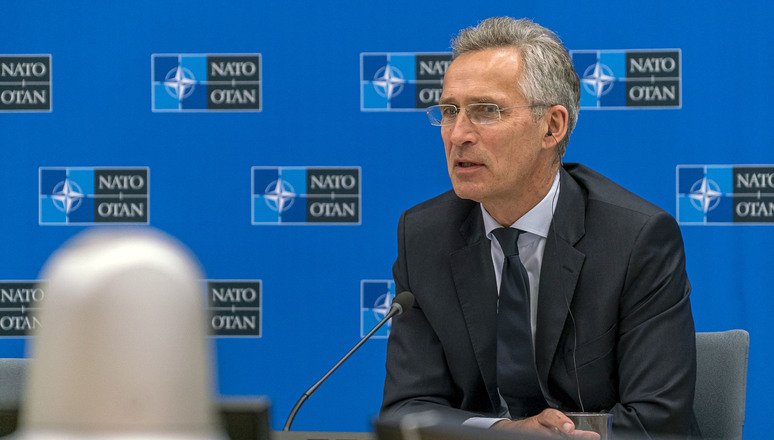
BRUSSELS. ReportDifesa publishes the full speech by NATO Secretary General Jens Stoltenberg at the joint meeting of the European Parliament’s Committee on Foreign Affairs (AFET) and the Subcommittee on Security and Defence (SEDE) followed by an exchange of views with Members of the European Parliament.
“Thank you so much, madam chair, David, Natalie, and dear friends in the European Parliament. It is really a great pleasure to see you again, to engage with you again here in the European Parliament because I really appreciate this expression of NATO-EU cooperation, to meet with you. And as you know, to strengthen the cooperation between NATO and the European Union has been a top priority for me, since I started my tenure as Secretary General of NATO in 2014. I believe in NATO-EU cooperation, because we share the same values. We share the same challenges. We are two different organizations, so but we have a lot in common.
As you know, 600 million Europeans live in a NATO country. And when Sweden joins NATO, 96% of the citizens of the European Union live in NATO country. So yes, we are different, different institutions, but we have a lot in common. And therefore it is good to see that over recent years, we have been able to strengthen NATO-EU cooperation, on cyber, on space, on critical infrastructure, on military mobility and we work hand in hand in the Western Balkans, in Kosovo, and also in addressing the illegal migration in the Aegean Sea, and in many other areas.
And this is also reflected through the fact that, as you refer to, that earlier this year, I signed the third Joint Declaration between the two EU presidents. President von der Leyen and President Michel. They participated in the EU summit in Vilnius, [inaudible] was there. As I participated in June, I met with all the all the EU leaders in the European Council. So we meet at different levels, we work closely together, reflecting the reality that we have so much together and need to work together.
So I would like to commend you as a European parliamentarians for supporting these efforts, enabling the strengthened cooperation between the European Union and NATO. And of course, we have a lot more to do, but we can be be quite proud of how far we have been able to move over the last years in in ensuring the partnership, the bond between our two organizations.
NATO-EU cooperation has always been important, but the war in Ukraine has made it even more important because this is the most brutal war we have seen, the biggest war we have seen in Europe since the Second World War. And that makes it even more important that we stand together.
And the reality is that President Putin made at least two big strategic mistakes when he invaded Ukraine last year. The first and most important was, of course, that he totally underestimated the Ukrainians. The strength, the commitment, the courage of the Ukrainian people, the Ukrainian political leadership and the Ukrainian armed forces. The other big strategic mistake he made was to underestimate us. Our willingness, our commitment to support Ukraine, to stand by Ukraine, with economic sanctions, with political support, but not least, with the military support.
And that’s unprecedented, what we have seen now, of military support from NATO Allies, from EU members, from EU, from NATO. And, this is a support which is much bigger than anyone expected when this war started. With, with advanced artillery, with the long range cruise missiles, with advanced air defence systems, with a lot of ammunition and not least training from EU, from NATO Allies.
And now I would also like to commend the Netherlands, Denmark, and also Norway for announcing that they are ready to deliver F-16s. And many Allies have also announced that they’re ready to start a training of Ukrainian pilots and technicians to enable them to have F-16s.
So again, there’s much more we need to do, we need to support and sustain this support. But if we just stop for a moment and think where we are today, compared to where we thought we were going to be just weeks ahead of the invasion. I think we need to recognize the strength, the commitment, not least enabled by the European Parliament, for EU members, for NATO Allies, for our institutions, to stand by Ukraine.
And that’s extremely important to recognize because this is something that needs to continue. Our support has helped to enable the Ukrainians to launch the counter offensive. The Ukrainians are gradually gaining ground and it proves the importance of our support and also our ability and willingness to continue the support, because this is heavy fighting, difficult fighting, but they have been able to breach the defensive lines of the Russian forces and they are moving forward.
And that was also the clear commitment and clear message from the NATO summit in July. That we need to continue to support Ukraine. That has been the message from the European Union, again and again. And the offensive just highlights the importance of standing by them.
At the NATO Summit, the main message was of course to support Ukraine. We were also able to make progress on Ukraine’s path towards NATO membership.
We recognize what the European Union has done, in granting them candidate status. In NATO, at the Vilnius summit we made important decisions to help to move Ukraine closer to membership.
We reiterated that Ukraine will become a member of NATO, but then we added three elements which actually move them closer membership.
First, we agreed a substantial package and also funding for a substantial package to ensure full interoperability between the Ukrainian Armed Forces and NATO, and interoperability between our armed forces. And it’s really a way to, in practical terms, to move Ukraine closer to NATO membership. The second thing we did was to strengthen their political institutionalized cooperation. We established something called the NATO-Ukraine Council, where we don’t meet Ukraine as a partner, we meet as equals around the table. 31 Allies, soon 32, and then with Ukraine, around the table as an equal.

This council can make decisions. It can convene on a short notice, it can address crisis, as we did just after the summit, when the when the grain deal was suspended. And the plan is now to really develop the NATO-Ukraine [Council], to a practical, to an important tool, to strengthen the bonds between NATO and Ukraine.
And the third thing we did at the NATO summit was to remove the requirements for Membership Action Plan for Ukraine to become a member. Because previously the idea was to grant the country Membership Action Plan and that was a step towards invitation. At the Vilnius summit, we said that there is no need for Membership Action Plan. Because Ukraine has only moved closer to NATO. So we turn now the membership process from a two-step process to a one step process.
And these three things, the interoperability, the NATO-Ukraine Council and removal of the requirement for Membership Action Plan for Ukraine, demonstrates that Ukraine has never been closer to a membership in NATO than now.
And let me just end by saying that this reflects the political reality that nations are sovereign. Nations decide themselves, and Ukraine has of course the right to decide its own path. And it’s up to Ukraine and NATO Allies to decide when Ukraine becomes a member. Russia cannot veto membership for any sovereign independent state in Europe. The other main issue at the NATO summit was to strengthen our deterrence and defence. Because fundamentally NATO has two tasks when it comes to the war in Ukraine. One is to support Ukraine as NATO Allies and NATO does. The second is to prevent the escalation.
Therefore, we have already increased our presence in eastern part of the Alliance, to send a very clear message to Moscow. To remove any room for misunderstanding, miscalculation. That NATO is there to defend every inch of NATO territory, one for all for one.
At the NATO summit, we agreed new plans for the defence of the whole Alliance. We also agreed to establish and identify more high readiness troops, 300,000 troops on different levels of high readiness, and also have more air and naval capabilities, ready to quickly reinforce if needed.
The purpose of this is to prevent war. The purpose of this is to ensure that NATO continues to be the most successful Alliance in history because we have prevented any military attack on any NATO Allies. And when there’s a full-fledged war going on in Europe, then it becomes even more important that we have credible deterrence and by strengthening our deterrence and defence, we are preventing war, preserving peace for NATO Allies, because there’s no room for miscalculation.
And the third thing was that NATO Allies have really now demonstrated that they are delivering on the commitment we made in 2014, because the war didn’t start in February last year. It started in 2014. The full-fledged invasion happened last year, but the war, the illegal annexation of Crimea, Russia went into eastern Donbas in 2014.
Since then, NATO has implemented the biggest adaptation on this Alliance in modern history, in decades. And part of that is to invest more in defence. I think I’ve told you before that I know it’s hard to allocate money for defence, because most politicians want to spend money on health, on education, on infrastructure instead of defence. But sometimes you have to invest in defence and when tensions are going up, risks are increasing [inaudible] we have to invest more.
And this year, we expect NATO Allies to increase defense spending by more than 8% in [inaudible] terms. This is the biggest increase in decades, and most of them are also EU members, are now taking this very seriously. More money for defence also enable us to invest more in production of ammunition, which is extremely critical. I welcome the efforts. I welcome the decisions by the European Union, which go hand in hand what we do in NATO. In NATO we have different arrangements for joint procurement of ammunition, we have done that for many years. We have something called a NATO support and procurement agency. I welcome efforts by EU members, NATO Allies, to ramp up production and we work closely with the defence industry throughout the Alliance, in EU but also in non EU Allied countries. To produce more and more spending, is a precondition for also increased production.
Then lastly on Sweden. First of all, it is historic that now Finland is member of the Alliance. And we have to remember the background. The background was that President Putin declared in the autumn of 2021, and actually sent a draft treaty that they wanted NATO to sign, to promise no more NATO enlargement. That was what he sent us. And was a pre-condition for not invade Ukraine. Of course we didn’t sign that.
The opposite happened. He wanted us to sign that promise, never to enlarge NATO. He wanted us to remove our military infrastructure in all Allies that have joined NATO since 1997, meaning half of NATO, all the Central and Eastern Europe, we should remove NATO from that part of our Alliance, introducing some kind of B, or second class membership. We rejected that.
So he went to war to prevent NATO, more NATO, close to his borders. He has got the exact opposite. He has got more NATO presence in eastern part of the Alliance and he has also seen that Finland has already joined the Alliance and Sweden will soon be a full member. Because at Vilnius Summit, we agreed a statement where it was clearly expressed how Sweden will do more, follow up the agreement we had in Madrid on fighting terrorism, and also address issues related to export of military equipment, and then Türkiye made it clear that they will ratify as soon as possible.
This has been reiterated by President Erdogan several times. So I expect that when the Turkish parliament reconvenes later this autumn the ratification will happen as soon as possible, which has been stated again and again. And then we will be 32 Allies, and both Sweden and Finland will be members.
This is this is good for the Nordic countries. It’s good for Finland and Sweden. And it’s also good for NATO. And it demonstrates that when President Putin invaded a European country to prevent more NATO, he’s getting the exact opposite.
I think have used my 10 minutes or even more so. So I think I stop there to allow as much time as possible for the comments and questions and I am looking forward to our discussions. Thank you so much”.
© RIPRODUZIONE RISERVATA